
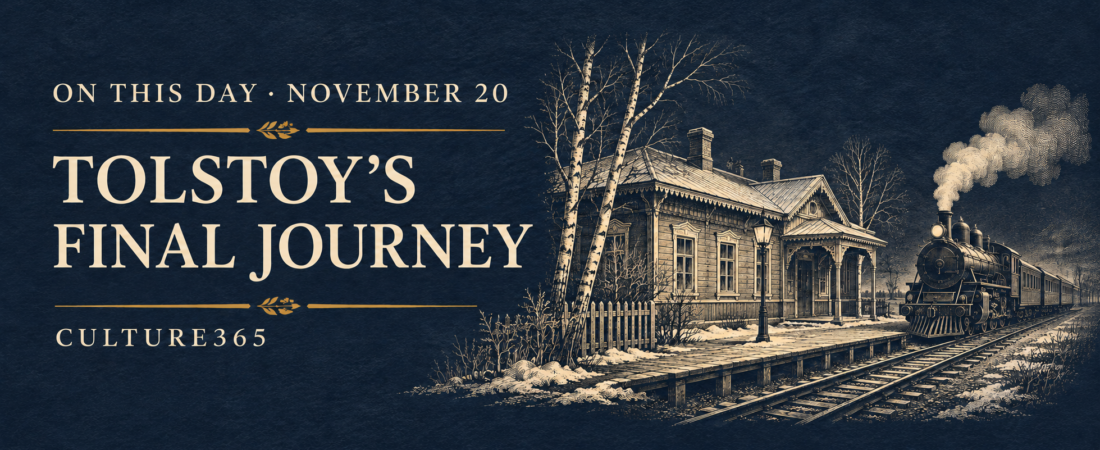
Tolstoy’s Final Journey: The Last Days of the Author of War and Peace
On This Day · November 20
Tolstoy’s final journey began before dawn, when he left the estate where he had written War and Peace and Anna Karenina. He was eighty-two, and he slipped away from Yasnaya Polyana with his doctor, Dušan Makovický. Ten days later, on November 20, 1910, he died of pneumonia in a railway stationmaster’s house at Astapovo. By then, a departure he had tried to keep private had become a story followed across Russia.
Why Tolstoy left Yasnaya Polyana
Yasnaya Polyana was Tolstoy’s family home and the place most closely associated with his writing. In his last years, however, conflict within the household made life there increasingly difficult. His departure came after years in which his convictions about how to live sat uneasily alongside the realities of family life. Reducing the decision to a single argument would miss what made it so painful: leaving meant walking away from a place, a marriage and a set of responsibilities that had shaped his adult life.
It is tempting to read the journey as if Tolstoy were writing the ending of one of his own novels. But the circumstances were less tidy. He could decide to leave; he could not decide how his family would experience his absence or what strangers would make of it. The gap between those things became clear almost immediately. Newspapers learned that he had gone before they knew where he was, and that uncertainty helped turn his departure into national news.
Tolstoy’s final journey ends at Astapovo
Tolstoy became ill while travelling by train and got off at Astapovo. The stationmaster took him in, and the house became the place where he spent his final days. He died there of pneumonia on November 20, 1910. Some accounts give November 7: that is the same day in the Julian calendar then used in Russia. Likewise, his departure on October 28 in Russian records corresponds to November 10 in the Gregorian calendar.
Astapovo matters to the story because it was an interruption. Tolstoy had not set out to die there. A railway stop that would ordinarily have been a point on someone else’s itinerary became the place where his family, his doctors and the press had to reckon with the possibility that he would not travel any further. In accounts of his last days, the station is remembered less for where its trains went than for who had to stop there.
A private departure becomes public news
The press had a compelling story before it had much information: a famous writer had left his home secretly, and his whereabouts were initially unknown. At Astapovo, the focus shifted from where Tolstoy had gone to whether he would recover. Historian William Nickell’s study of the episode shows how coverage of the writer’s last days helped shape the story that later generations inherited. The reports were part of the event as people experienced it, not simply a record assembled afterwards.
That attention is understandable. Readers who had spent hundreds of pages in the company of Tolstoy’s characters wanted to know what was happening to the man who had created them. Yet the reports could describe his movements and condition more easily than they could explain his decision. The detail that made the story so compelling — that he left quietly, with little explanation available to the public — was also what made it so easy to fill the silence with speculation.
The return to Yasnaya Polyana
Tolstoy was buried at Yasnaya Polyana, near a ravine on the estate. His journey thus ended, after his death, in the place from which it had begun. Astapovo is where illness stopped him; Yasnaya Polyana is where he had lived, written and chosen to be buried. Both places belong to the story, and neither alone explains why he left.
For readers of War and Peace, there is something familiar in the way this small sequence of events widens: a decision taken inside a household, a change of plans on a railway journey, and then a country reading about a stranger’s sickroom. The facts fit into a few lines. What makes them worth returning to is the tension between a man trying to make a decision for himself and a public already turning that decision into a story of its own.
Sources & Further Reading