
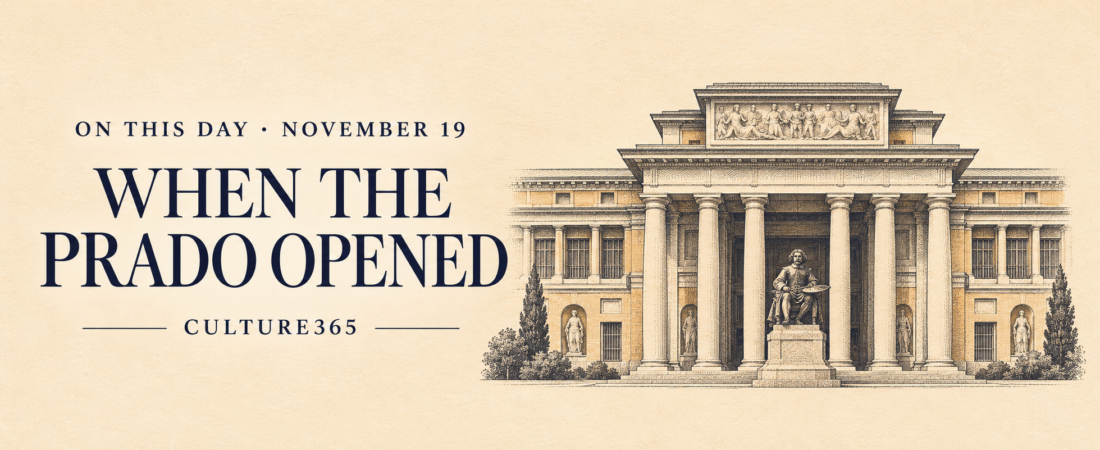
How the Prado Opened Spain’s Royal Art Collection to the Public
On This Day · November 19
When the Prado opened to the public on November 19, 1819, visitors to Madrid could enter a museum founded on paintings assembled by generations of Spanish monarchs. The collection had been formed in royal residences, where paintings served as objects of devotion, records of dynastic power and expressions of personal taste. In the museum, they could be seen together by people who had no place at court. The Prado’s opening changed who could see these works and what they could mean to the people looking at them.
A building designed for a different kind of museum
The building on the Paseo del Prado was never intended to house royal paintings. In 1785, under Charles III, the architect Juan de Villanueva designed it for the Natural History Cabinet. It was Ferdinand VII, encouraged by his wife, Queen María Isabel of Braganza, who decided to give the building a different purpose. It would become the Royal Museum of Paintings and Sculptures.
María Isabel took an active interest in the project. She painted herself and was associated with Madrid’s Royal Academy of Fine Arts of San Fernando. She died in December 1818, less than a year before the museum opened. In a posthumous portrait by Bernardo López, she points to architectural plans while the museum appears through a window. The painting gives her a role that a conventional royal portrait might have overlooked: it remembers her through a project she helped bring into being.
What visitors saw when the Prado opened
The Prado’s first catalogue listed 311 paintings, although the museum already held just over 1,510 pictures drawn from royal residences. And while the royal collection included works from across Europe, the museum’s opening display featured only paintings by Spanish artists. The distinction matters: the collection supplied the material, but the display made an argument about which artistic tradition deserved visitors’ attention first.
That decision also changed how viewers could look at the paintings. A portrait in a palace might first prompt a question about the person it depicts: who was this, and why did they matter to the court? In a gallery devoted to painting, a visitor could ask another set of questions. How did the painter direct the eye? How did light, scale or composition give a figure authority? And what could one painting reveal about another hanging nearby? The original courtly meanings remained, but the museum gave visitors room to make comparisons of their own.
From a royal collection to a national museum
The paintings gathered by Spain’s monarchs remained the foundation of the Prado, but the museum’s identity grew beyond that inheritance. It eventually became a national museum, and works entered from other institutions. The Museo de la Trinidad, for example, brought works including five canvases by El Greco made for the Colegio de Doña María de Aragón. Much of the Prado’s nineteenth-century painting collection came from the former Museo de Arte Moderno. Those additions broadened the histories the museum could tell.
The Prado also became a place where artists could learn by looking at earlier work. Its bicentenary exhibition traced that influence across generations, from Manet and Renoir to Picasso and Pollock. Seen from that perspective, opening the collection did more than make existing paintings accessible. It gave later artists a place to study, question and respond to them.
Why the opening still matters
The Prado’s story helps separate two ideas we often treat as one: possessing a collection and making it public. The Spanish Crown had assembled paintings for centuries. Turning those holdings into a museum meant choosing what to display, bringing works into new relationships and making them available to people who could form their own judgments. The first display was selective, and the museum continued to change as its collections and audiences grew. That process is part of what makes its history so revealing.
On November 19, 1819, the paintings did not lose their royal past. What they gained was a public life. A collection once encountered in the setting of the court could now become the subject of study, disagreement and pleasure for generations of visitors. The Prado’s opening is a reminder that a museum does more than preserve objects: it gives people a place to look at them together.
Sources & Further Reading