
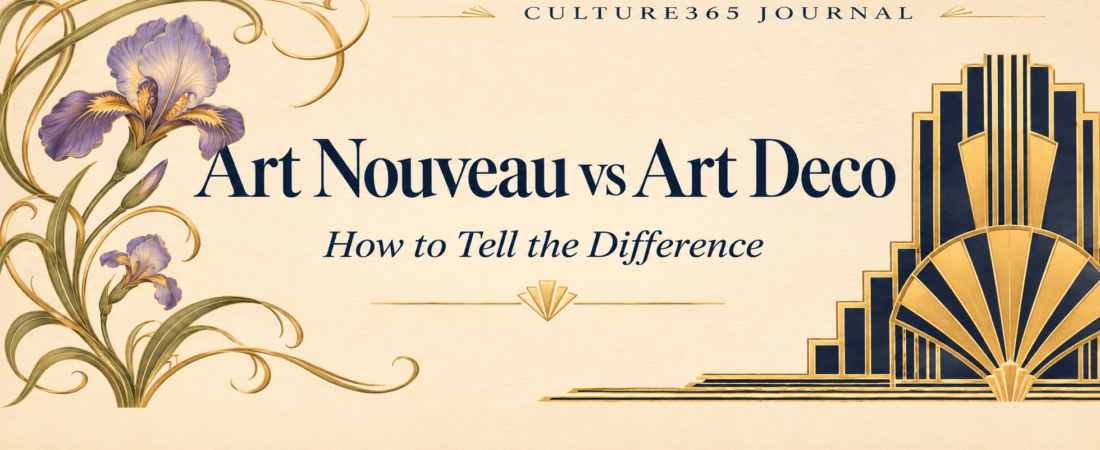
Art Nouveau vs Art Deco:
How to Tell the Difference
A curling iron doorway, a geometric necklace, a richly decorated cabinet: the clues that separate two influential design styles are often hiding in plain sight.
The easiest way to distinguish Art Nouveau vs Art Deco is to look at the lines. Art Nouveau often flows like a climbing plant. Art Deco frequently builds its patterns from repeated angles, geometric shapes and clearly organised forms.
That distinction is useful, but it is only a starting point. Art Nouveau can be geometric, and Art Deco can include flowers and curves. To tell them apart confidently, consider the design’s date, composition and treatment of ornament together.
Art Nouveau vs Art Deco at a Glance
These are tendencies rather than strict identification rules. Regional differences and individual designers complicate any simple checklist.
What Is Art Nouveau?
Art Nouveau developed in the late nineteenth century as artists and designers searched for a new visual language. Its name means “new art” in French.
Rather than treating decoration as something added at the end, designers could integrate it into the object or building itself. A stair railing might resemble a stem; a handle might continue the movement of a door’s surrounding ornament.
Nature provided a rich vocabulary, from leaves and flowers to insects and animal forms. The characteristic “whiplash” line curves sharply before sweeping away again.
The movement was international. Related approaches developed under names including Jugendstil in Germany and Stile Liberty in Italy, while designers in different places interpreted its ambitions in distinctive ways.
What Is Art Deco?
Art Deco is closely associated with the decorative arts of the interwar years. The 1925 International Exhibition of Modern Decorative and Industrial Arts in Paris became a defining showcase, although the style was already established by then. Its name was adopted retrospectively from the exhibition’s title.
French Art Deco combined modern design with established traditions of luxury craftsmanship. Furniture, textiles, jewellery and decorative objects could feature rich materials, precise detailing and strongly organised ornament.
Geometric abstraction was important, but so were human figures, flowers and animals. A floral motif alone, therefore, does not make an object Art Nouveau.
Three Ways to Recognise the Difference
1. Follow the Line
Look closely at a railing, a printed border or the outline of a chair.
Does the line bend and branch, suggesting a living organism? That supports an Art Nouveau reading.
Does it form repeated angles, stepped shapes or a tightly controlled pattern? That may point towards Art Deco.
Do not decide from one detail. Examine how those lines organise the whole design.
2. Look at How Nature Is Transformed
Both styles draw on nature. The difference often lies in how a natural subject is handled.
An Art Nouveau flower may unfold into a winding network of stems. An Art Deco flower may be simplified into a compact, repeated decorative shape.
Think of this as a comparison exercise, not a universal rule: look for whether the overall design emphasises organic movement or geometric organisation.
3. Check the Date and Designer
A date can help resolve an uncertain impression, although later revivals mean appearance and age do not always match.
Museum records are particularly useful. A maker’s name, production date and material description provide firmer evidence than a seller’s broad stylistic label.
Examples That Make the Distinction Clearer
For Art Nouveau, explore Victor Horta’s Hôtel Tassel in Brussels. The V&A describes Horta’s buildings as integrated works in which elements such as banisters, stained glass and handles participate in the decorative scheme.
For another perspective, examine Charles Rennie Mackintosh’s designs. Their disciplined geometry challenges the assumption that Art Nouveau always means elaborate curves.
For Art Deco, compare Émile-Jacques Ruhlmann’s furniture with Gérard Sandoz’s cigarette cases. The former demonstrates refined craftsmanship; the latter makes the appeal of geometric ornament particularly easy to see. Both appear in the V&A’s introduction to the style.
Why Are the Two Styles Sometimes Confused?
They share more than similar names.
Both extended across multiple forms of design, and Art Deco developed partly from earlier approaches, including Art Nouveau. The relationship was especially close where Art Nouveau designers had already explored linear and geometric forms.
The V&A identifies designers such as Mackintosh and Josef Hoffmann as important to this connection. Art Deco also drew on other sources, including avant-garde art and the imagery of modern urban life.
A Practical Way to Remember Them
Begin with organic movement for Art Nouveau and structured geometry for Art Deco. Then test that first impression against the object’s date, designer and wider composition.
The reward is a different way of looking. A doorway, a lamp or a textile becomes evidence of how designers imagined modern life—and how they brought that vision into everyday surroundings.
Sources & Further Reading